Djamel’s Gang Beats Lukas in the Park
Sonne und BetonDjamel’s Gang Beats Lukas in the Park turns an encounter Lukas hoped to avoid into a public beating, then brings him back to the same confrontation in a larger, more volatile clash. The episode hinges on the pressure of being watched: insults and attempts to save face narrow the space for retreat, while Lukas’s bodily fear and eventual paralysis expose how little control he has over the violence around him.
The Encounter Becomes a Challenge
Lukas objects when Julius leads the group through the park rather than around it. He knows Cem and the other boys are at the far end and wants to avoid the men who gather near the entrance. The littered grass, scattered beer mats, and glinting shards of glass reinforce his sense that the route is needlessly hostile. As the boys pass a man sitting with four friends, the man offers them amphetamines, cocaine, or cannabis at a good price. Lukas keeps walking and does not answer. He wants to reach Cem and get home without inviting trouble.
When the seller calls after them, Gino also looks down and continues on. Julius, however, stops to refuse the offer. He then adds that, even if they wanted anything, they would not buy it from Turks. The insult transforms a declined transaction into a confrontation. Lukas pulls Julius by his hoodie, trying to get him moving again, but the seller steps in front of Lukas, spits through a gap in his teeth, and shoves him. His friends form a semicircle around the boys. Lukas feels heat, a racing heart, and a slight tremor; the scene’s physical pressure arrives before he can find a way to defuse it.
Lukas Is Beaten and Humiliated
Lukas apologizes and says they are in a hurry. The seller calls him a German victim, mocks his stammer, and demands to know why he pulled Julius away. Lukas tries to hold the man’s gaze because he believes looking down would make him seem weak and invite a beating. His voice nevertheless breaks as he asks to leave. Julius then says that he and Djamel knew each other from primary school, invoking their former teacher and classmates in an attempt to make Djamel let Lukas go. Lukas is startled that Julius has withheld this connection until now.
The appeal does not stop Djamel. He presses his forehead against Lukas’s, spreads his arms, and continues to insult him. When Djamel spits beside him, Lukas reflexively follows the spit with his eyes; Djamel’s fist lands on his right cheekbone. One of the other men kicks Lukas in the stomach, while another films him on a phone. Gino and Julius remain rigid and do not intervene. Djamel strikes Lukas again in the nose, making his eyes water as blood runs over his mouth and drips onto the dry grass, then hits him in the solar plexus and leaves him gasping for breath.
The assault ends not with an apology or a rescue but with Djamel wiping Lukas’s blood from his fist onto his shirt and pushing his face away. Djamel says he is fortunate to have caught him on a day when he is being kind, adding that under other circumstances he would stab him. The group spits after the boys and laughs as they leave. The threat makes clear that the beating is also a warning: Lukas is being told that the violence could have gone further, and that his departure depends on Djamel’s decision to let him go.
The Aftermath and the Return
A short distance away, two adults sit on the grass smoking a water pipe, talking and laughing. Lukas believes they witnessed the beating and resents that they did not even call out. Their passivity deepens his sense of isolation. A bottle collector, by contrast, silently offers him a tissue. Lukas accepts it, then uses the back of his phone as a mirror and sees the damage to his face. He worries that his father will see him and blame him, even though Lukas insists to himself that being beaten was not his fault. He thinks his father does not understand how much the neighborhood has changed since his own upbringing, and rejects the familiar advice that the wiser person gives way as inadequate to the situation he has just faced.
The injury remains visible the following day. When Momo asks what happened to Lukas’s face, Lukas says he had some trouble the day before; Momo asks whether it was a fight, and Lukas briefly nods. The exchange confirms the beating’s immediate physical aftermath without resolving what Lukas should have done or what his friends’ inaction means.
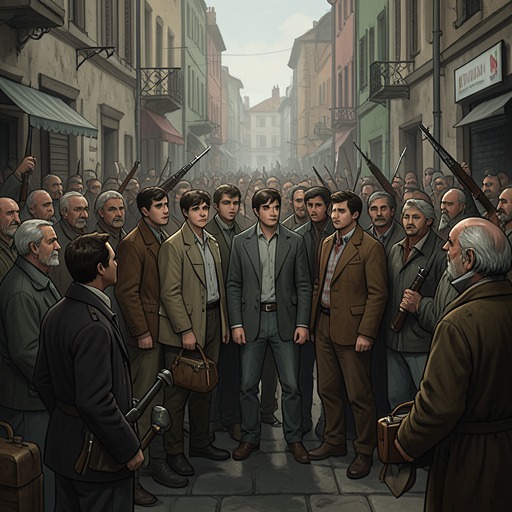
Later, the group returns to the bank where the first confrontation began. At least ten people are gathered there, laughing over something on a phone; Lukas suspects they are watching the video of his beating. One of the boys whistles, drawing attention from nearby apartment blocks, and the crowd starts toward them. Cem is with Lukas now, and two of Cem’s brothers arrive behind Djamel’s group. Lukas grips a club and hears himself urging action, but when Djamel steps forward and taunts him about carrying it, Lukas’s legs will not move. He looks at Gino and Julius, shakes his head, and drops the club.
Violence Spreads Beyond Lukas
Djamel’s challenge brings the earlier humiliation back into the open, but the second confrontation does not become Lukas’s revenge. Cem, standing beside him, goes at Djamel without speaking and strikes him in the face with his left elbow. Djamel’s temple splits and his face fills with blood. Cem shouts that he will kill him; Djamel’s friends rush Cem, while one of Cem’s brothers grabs the club Lukas dropped and swings blindly. Cem’s brothers pull attackers away, shove them down, and kick them as shouting and blows spread through the park. Gino grabs Lukas by the shoulder and looks panicked.
The contrast between the two encounters is central to the episode. In the first, Lukas tries to escape the confrontation, then tries to apologize and keep his gaze steady, but is beaten while Julius and Gino stand still. In the second, Lukas arrives armed and tells himself to strike, yet freezes when Djamel addresses him; the weapon falls from his hand, and Cem initiates the violence instead. The return does not restore Lukas’s control or undo the earlier public degradation. It converts a personal beating into a group brawl, with the filmed humiliation and the crowd’s attention helping carry the first encounter into the next.